

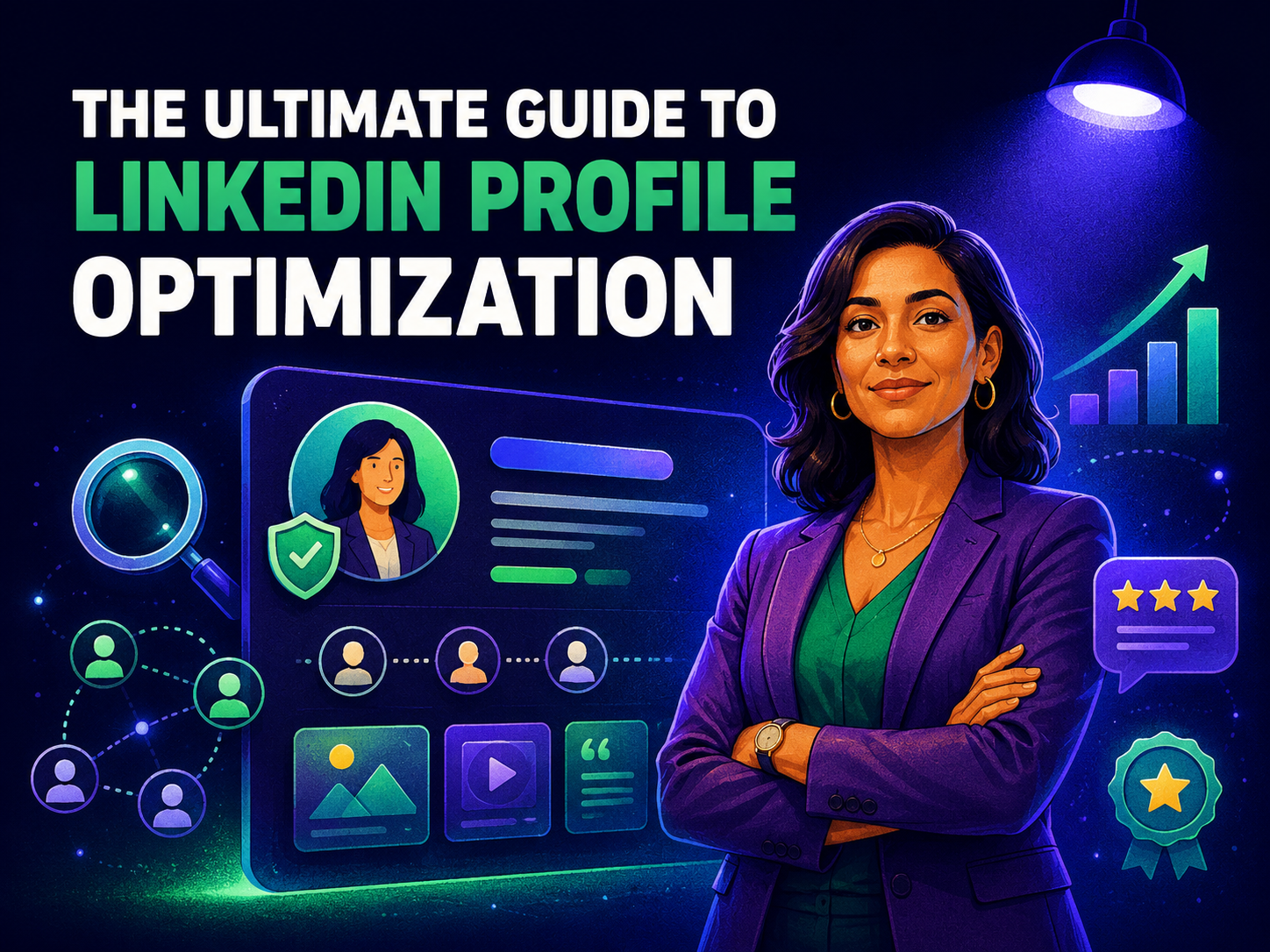
Your LinkedIn profile is no longer just an online résumé.
It is your digital first impression.
Before a recruiter contacts you, a client schedules a meeting, or an investor responds to your pitch, there's a good chance they've already viewed your LinkedIn profile.
Within seconds, visitors begin forming opinions about your credibility, expertise, leadership, and professional value.
The question isn't whether people are evaluating your profile.
The question is whether your profile accurately represents the professional you've become.
Many professionals spend years developing expertise but only minutes maintaining the profile that often shapes important opportunities.
LinkedIn profile optimization is about closing that gap.
This guide explains how to transform your profile into a strategic professional asset that communicates trust, authority, and expertise while supporting your long-term career and business goals.
Why LinkedIn Profile Optimization Matters
Today's professionals operate in a digital-first world.
Recruiters search LinkedIn before reviewing résumés.
Clients research consultants before scheduling meetings.
Employers evaluate leadership candidates online.
Journalists research experts before requesting interviews.
Conference organizers review speakers.
Investors evaluate founders.
Potential employees research executives.
For many professionals, LinkedIn has become the first conversation before the first conversation.
A well-optimized profile can help communicate professionalism, while an outdated or incomplete profile may create uncertainty about your experience or expertise.
Check My Influence Score - FREE →
What Is LinkedIn Profile Optimization?
LinkedIn profile optimization is the process of improving every section of your profile so it clearly communicates your professional value.
An optimized profile should answer five important questions.
- Who are you?
- What do you specialize in?
- Why should someone trust you?
- What have you accomplished?
- Why should someone connect with you?
Every profile element contributes to answering those questions.
Define Your Professional Positioning
Before updating your profile, define what you want people to remember about you.
Ask yourself:
- What industry do I serve?
- What problems do I solve?
- What expertise am I known for?
- Who do I want to attract?
- What opportunities am I seeking?
Strong positioning creates consistency throughout your profile.
Optimize Your Profile Photo
Your profile photo is often the first thing people notice.
Use a recent, professional-quality image that reflects your industry and role.
A good profile photo should communicate:
- Professionalism
- Confidence
- Approachability
- Authenticity
Avoid heavily edited images, distracting backgrounds, or casual photos that don't match your professional goals.
Make Your Banner Work for You
Your banner is valuable visual space.
Instead of leaving the default background, use it to reinforce your professional identity.
Consider including:
- Industry focus
- Areas of expertise
- Professional mission
- Company branding
- Speaking engagements
- Publications
- Certifications
- Professional tagline
The banner should complement your profile-not distract from it.
Write a Strong LinkedIn Headline
Many professionals simply list their job title.
Your headline should communicate value.
Instead of:
Marketing Manager
Consider:
Marketing Manager | B2B Growth Strategy | Demand Generation | Helping Technology Companies Scale Revenue
A strong headline should include:
- Current role
- Area of expertise
- Industry keywords
- Professional focus
- Value proposition
This improves both readability and discoverability.
Check My Influence Score - FREE →
Create an Effective About Section
Your About section tells your professional story.
Instead of repeating your résumé, explain:
- What you do
- Why you do it
- Who you help
- What experience you bring
- What differentiates you
Support your statements with examples rather than broad claims.
End your About section by inviting readers to connect or continue the conversation.
Showcase Results in Your Experience Section
Employers already know what your job title means.
What they want to understand is your impact.
Instead of listing responsibilities, highlight outcomes.
For example:
Instead of:
Managed marketing campaigns.
Write:
Led integrated marketing campaigns that increased qualified lead generation while supporting product launches across multiple markets.
Focus on measurable contributions whenever possible.
Use the Featured Section Strategically
The Featured section allows you to demonstrate your expertise.
Include content such as:
- Articles
- Research
- Presentations
- Podcasts
- Interviews
- Videos
- White papers
- Portfolio projects
- Speaking engagements
Think of it as your professional showcase.
Build Trust Through Recommendations
Recommendations provide third-party validation.
Request recommendations from:
- Managers
- Colleagues
- Clients
- Business partners
- Mentors
Strong recommendations highlight:
- Expertise
- Leadership
- Communication
- Collaboration
- Results
These testimonials reinforce the credibility you communicate throughout your profile.
Keep Your Skills Current
Review your Skills section regularly.
Remove outdated skills.
Add skills aligned with your current expertise.
Prioritize the skills that best support your professional goals.
Relevant skills also help improve profile discoverability.
Demonstrate Continuous Learning
Education doesn't end after graduation.
Include:
- Professional certifications
- Executive education
- Industry training
- Specialized courses
- Professional development programs
Continuous learning demonstrates adaptability and commitment to growth.
Build Authority Through Content
An optimized profile is only one part of your LinkedIn presence.
Consistent content helps reinforce your expertise.
Share:
- Industry insights
- Lessons learned
- Professional experiences
- Case studies
- Original perspectives
- Commentary on industry trends
Focus on educating rather than promoting.
Over time, valuable content helps establish credibility and thought leadership.
Build a Strategic Network
Connections are more valuable than connection counts.
Focus on building relationships with:
- Industry peers
- Clients
- Recruiters
- Professional associations
- Alumni
- Thought leaders
- Business partners
Meaningful engagement often creates stronger long-term opportunities than simply expanding your network.
Optimize for LinkedIn Search
LinkedIn functions as a search engine.
Use relevant keywords naturally throughout your:
- Headline
- About section
- Experience
- Skills
- Content
Avoid excessive keyword repetition.
Write for people first, search second.
Common LinkedIn Profile Mistakes
Many professionals unintentionally weaken their profiles by:
- Using a generic headline
- Leaving the banner blank
- Writing a vague About section
- Listing duties instead of achievements
- Having few or no recommendations
- Rarely updating their profile
- Sharing little or no original content
- Using an outdated profile photo
- Providing inconsistent messaging
- Ignoring networking opportunities
Small improvements across several sections often create a stronger overall impression than changing only one area.
Check My Influence Score - FREE →
Profile Optimization by Career Stage
Young Professionals
Focus on:
- Education
- Projects
- Internships
- Certifications
- Volunteer experience
- Career aspirations
Job Seekers
Highlight:
- Recent accomplishments
- Transferable skills
- Measurable results
- Professional development
- Career objectives
Established Professionals
Emphasize:
- Leadership
- Business impact
- Industry expertise
- Strategic thinking
- Mentorship
Executives
Communicate:
- Vision
- Executive presence
- Organizational impact
- Industry leadership
- Speaking engagements
- Board experience
- Media recognition
- Thought leadership
Measure More Than Profile Completeness
A complete profile doesn't necessarily communicate influence.
Professional influence reflects how effectively your profile builds trust, demonstrates expertise, establishes credibility, and positions you for future opportunities.
That's why optimization should go beyond checklists.
It should evaluate how your profile is likely to be perceived.
The LinkedIn Professional Influence Assessment™ was created to help professionals better understand that perception.
Rather than focusing only on profile completeness, the assessment evaluates multiple dimensions of professional influence, including:
- Credibility
- Trust
- Authority
- Executive Presence
- Visibility
- Networking
- Personal Branding
- Thought Leadership
- Engagement
- Career Capital
Together, these dimensions provide a more complete understanding of your professional presence on LinkedIn.
LinkedIn Profile Optimization Checklist
Before considering your profile complete, ask yourself:
✓ Does my headline communicate my expertise?
✓ Does my profile photo appear professional?
✓ Does my banner reinforce my professional identity?
✓ Does my About section explain the value I provide?
✓ Does my experience highlight measurable achievements?
✓ Have I added relevant Featured content?
✓ Do I have current recommendations?
✓ Are my skills aligned with my expertise?
✓ Do I regularly publish valuable content?
✓ Does my profile reflect the professional I want others to see?
Frequently Asked Questions
How often should I update my LinkedIn profile?
Review your profile every few months or whenever you change roles, complete a significant project, earn a certification, or achieve a major professional milestone.
Does LinkedIn profile optimization help job seekers?
A well-maintained profile helps communicate your experience more effectively and can make it easier for recruiters and hiring managers to understand your qualifications.
What is a Professional Archetype™?
A Professional Archetype™ describes your dominant style of professional influence. It highlights how you naturally build credibility, communicate expertise, and create professional opportunities on LinkedIn.
Is LinkedIn profile optimization only for executives?
No. Professionals at every career stage can benefit from a profile that clearly communicates their experience, skills, and professional value.
Final Thoughts
Your LinkedIn profile is one of the few professional assets you control completely.
It has the potential to influence career opportunities, business relationships, professional visibility, and long-term reputation.
Optimizing your profile isn't about creating a perfect online image. It's about ensuring your LinkedIn presence accurately reflects the expertise, credibility, and value you've worked hard to build.
Every improvement—whether it's a stronger headline, a clearer About section, or more meaningful recommendations—helps tell a more complete professional story.
Discover Your Professional Archetype™
Your LinkedIn profile communicates more than your experience—it reflects how you build trust, demonstrate expertise, and influence professional opportunities.
Take the LinkedIn Professional Influence Assessment™ to identify your Professional Archetype™, understand your unique professional influence style, and receive personalized recommendations to strengthen your LinkedIn presence.
Identify Your Professional Archetype™ Today.